Can you become a dental receptionist with no experience?
Yes, and many people do. Dental offices hire front desk staff from retail, restaurants, hotels, call centers, banks and medical offices, because the hardest part of the job to teach is how to look after people. If you can stay friendly with a long line at the register or calm with an upset customer on the phone, you already have half of what the job needs.
The other half is dental: the words, the insurance, the schedule and the software. That's the part this guide (and our course) is about. The typical entry-level requirement is a high school diploma or equivalent, according to the Bureau of Labor Statistics. No license is required.
Step 1: Understand what the job really is
A dental receptionist runs the front of a dental practice. In a typical day you'll answer and make calls, book and confirm appointments, check patients in and out, verify insurance, collect payments, and keep the schedule full. In smaller offices one person does all of it; in bigger ones the work splits into roles like scheduling coordinator, insurance coordinator and treatment coordinator.
Before you apply, read what a dental receptionist does all day. It follows one day at a front desk hour by hour, so you'll know what you're signing up for.
Step 2: Learn the language of the dental office
On day one you'll hear things like "she's due for a recall with bitewings," "he needs SRP in two quads," and "the crown on #30 is back from the lab." You don't need to know everything, but you do need the basics:
- Who's who: dentist, hygienist, dental assistant, office manager, and specialists like oral surgeons and endodontists.
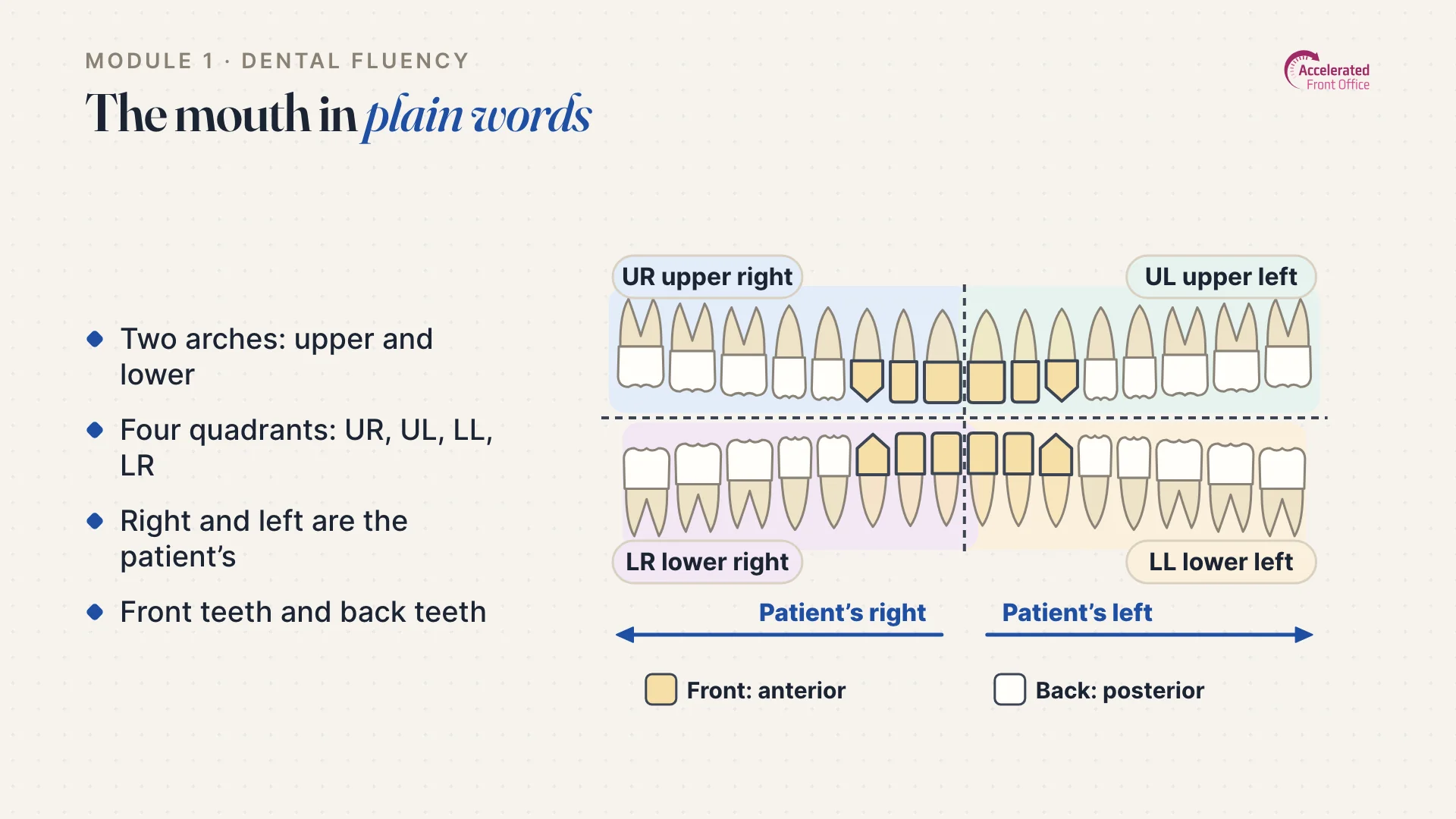
- Tooth numbers: US offices number adult teeth 1 to 32 and baby teeth A to T.
- Common procedures: exams, cleanings, x-rays, fillings, crowns, root canals, extractions, and how long each takes in the chair.
- The codes: each procedure has a CDT code (D1110 is an adult cleaning) that goes on the claim.
Start with our free dental terminology guide and the common CDT codes list.
Step 3: Get comfortable with dental insurance
Insurance is where most new hires struggle and where good ones stand out. You'll want to understand:
- The difference between PPO, HMO (DHMO) and fee-for-service plans, and what "in network" means.
- Deductibles, annual maximums, coverage percentages, frequency limits and waiting periods.
- How to verify a patient's benefits before the visit and turn them into an estimate.
- How to read an explanation of benefits and explain it to a patient.
The single most important rule: never promise a patient what their insurance will pay until the benefits are verified. It's the source of most billing disputes.
Step 4: Practice the phone calls
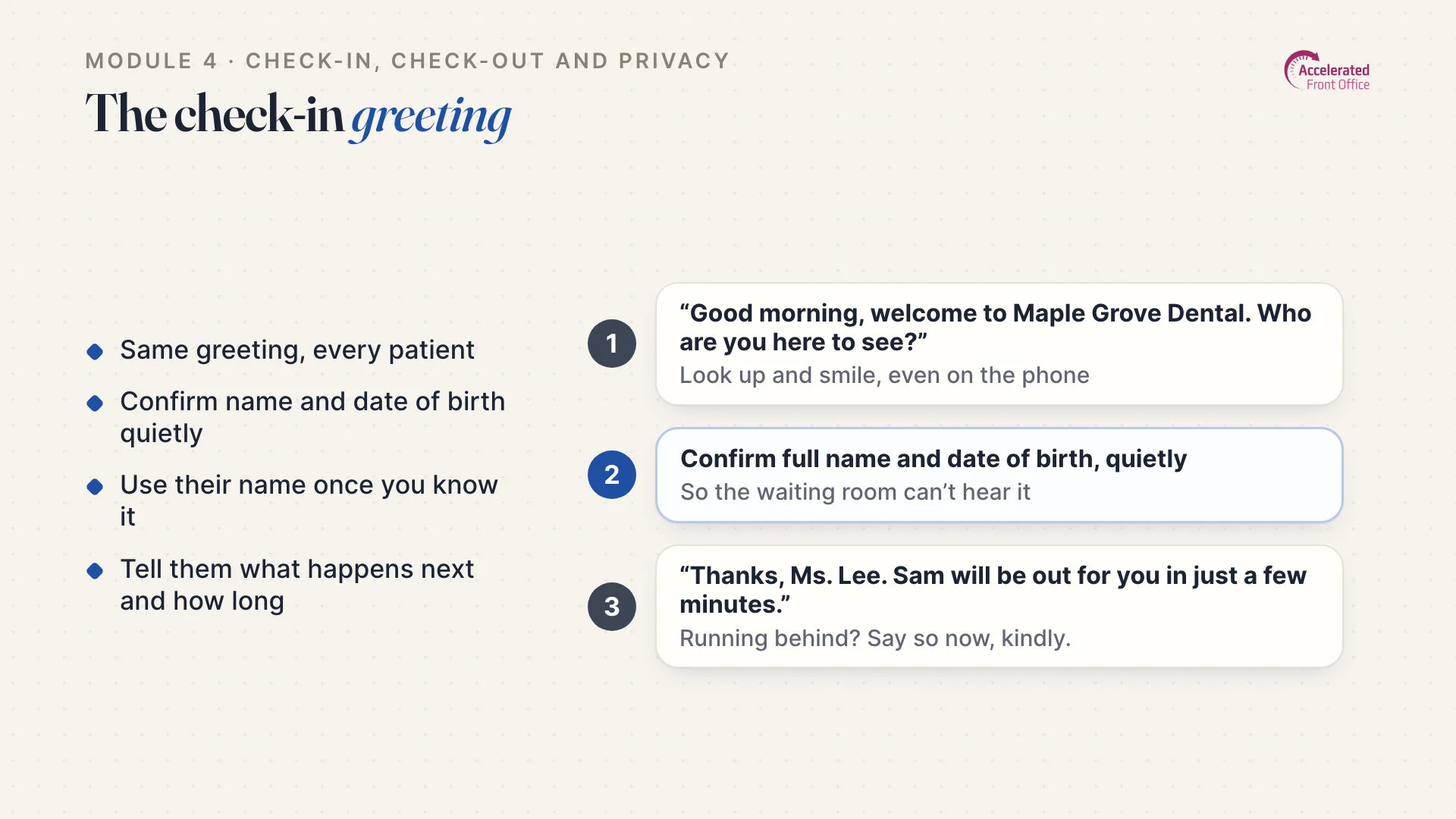
Phones are the heart of the job, and they're what interviews test. A great front desk call follows a simple pattern: answer the same way every time (practice name, your name, an offer to help), get the caller's name, find out why they're calling, show you heard them, offer two specific appointment times, and close with a recap.
Reading about calls only gets you so far. You need reps. In Front Office Essentials you take 24 practice calls with AI patients: a new patient, someone with a broken tooth, a price shopper, an insurance rep, a patient upset about a bill. Each call is scored, so you know exactly what to fix.
Step 5: Learn how a dental schedule works
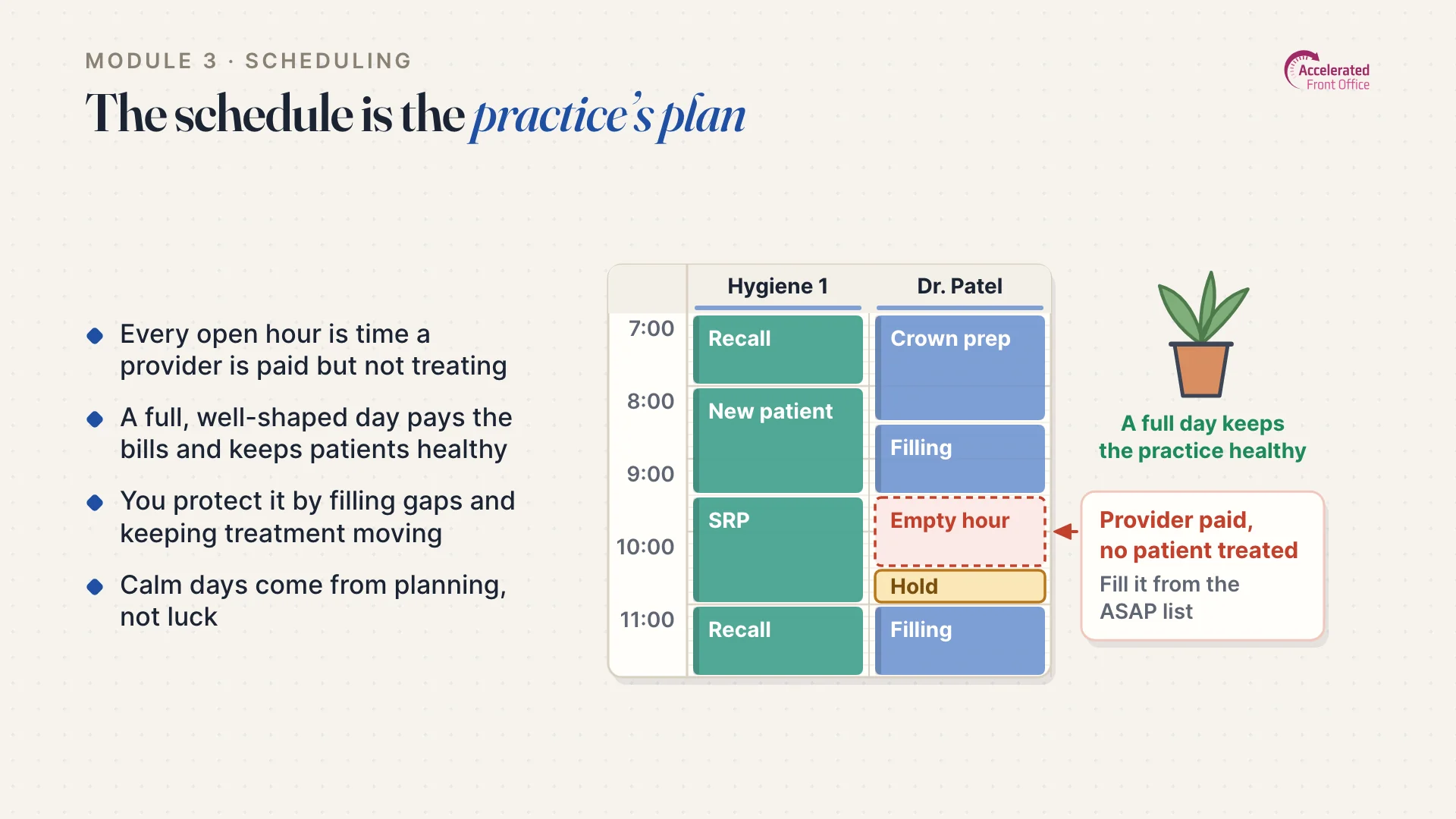
Dental schedules run in units (often 10 minutes), with a column for each dentist and hygienist. Good schedulers book big procedures in the morning, hold a slot or two for emergencies, and keep an ASAP list of patients who want an earlier time. When someone cancels, you call the list and fill the hole. Learn the typical length of the common visits so you never book a crown prep into a 30-minute gap.
Step 6: Consider a training certificate
A certificate isn't required (here's why), but if you have no dental experience it gives an office a reason to call you instead of the next applicant. Choose training where you practice the real work and get feedback, and that covers insurance, not just phones.
Step 7: Write a resume that speaks dental
Translate what you've done into what dental offices need. "Handled 60+ customer calls a day" becomes evidence you can run a phone line. "Processed returns and balanced the register" becomes evidence you can collect payments and close out the day. Our dental receptionist resume guide has a full example for someone with no dental experience.
Step 8: Find and apply for jobs
- Job boards: search "dental receptionist," "dental front desk," "patient coordinator" and "scheduling coordinator." Dental-specific boards like DentalPost list jobs too.
- Office websites: many private practices post openings only on their own site or social media.
- Temp and staffing agencies: dental temp work is a common way in, and a temp job can turn permanent.
- Your own dentist: ask. Offices often hire people they already know and like.
Apply to general dental practices first. They have the most front desk roles and are used to training new people.
Step 9: Prepare for the interview (and the working interview)
Expect questions about handling upset patients, juggling the phone and a patient at the desk, and talking about money. Many dental offices also do a "working interview": a few hours or a day at the desk so the team can see how you fit. Read our interview questions and sample answers, and practice saying your answers out loud.
Step 10: Make your first 30 days count
Your first month is mostly learning this office's way: its software, its policies, its insurance networks and its people. Write things down, ask before you promise anything about money or insurance, and learn every team member's name in the first week. Offices remember the new hire who made their day easier.
How long does it take to become a dental receptionist?
There's no fixed path, so it depends on you. Focused training takes a few weeks of evenings (Front Office Essentials is about 20 hours). A job search usually takes longer than the training. Many people go from deciding to start to their first day in one to three months.
Common questions
What qualifications do you need to be a dental receptionist?
Usually a high school diploma or equivalent, good customer service and communication skills, and comfort with computers. Dental knowledge (terminology, scheduling, insurance) is a big plus and can be learned through training before you apply.
Is being a dental receptionist hard?
The people side is busy but familiar to anyone from customer service. The hard part for most new hires is insurance: verifying benefits, estimates and EOBs. Learning those before you start makes the job much easier.