Who's who in a dental office
- Dentist (DDS or DMD): diagnoses and treats. The two degrees are equivalent.
- Dental hygienist (RDH): licensed to clean teeth, take x-rays and screen for gum disease. Runs the "hygiene column" of the schedule.
- Dental assistant: works chairside with the dentist. What assistants may do depends on the state.
- Office manager: runs the business side, and approves things like adjustments and payment exceptions.
- Specialists the office refers to: endodontist (root canals), periodontist (gums and implants), oral surgeon (extractions, implants), orthodontist (braces and aligners), pediatric dentist (children), prosthodontist (complex crowns, bridges and dentures).
How teeth are numbered
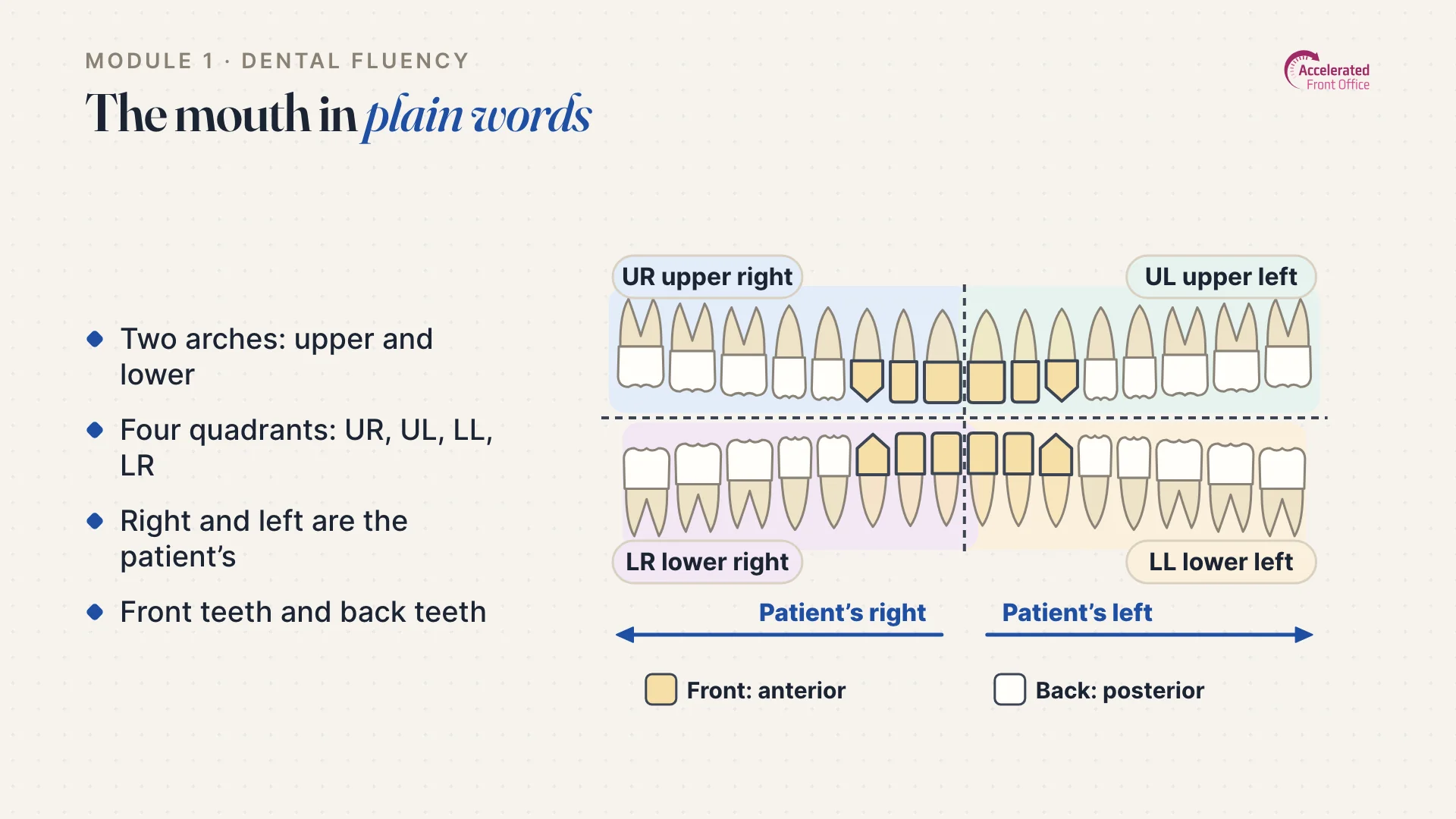
US offices use the Universal numbering system. Imagine you're facing the patient:
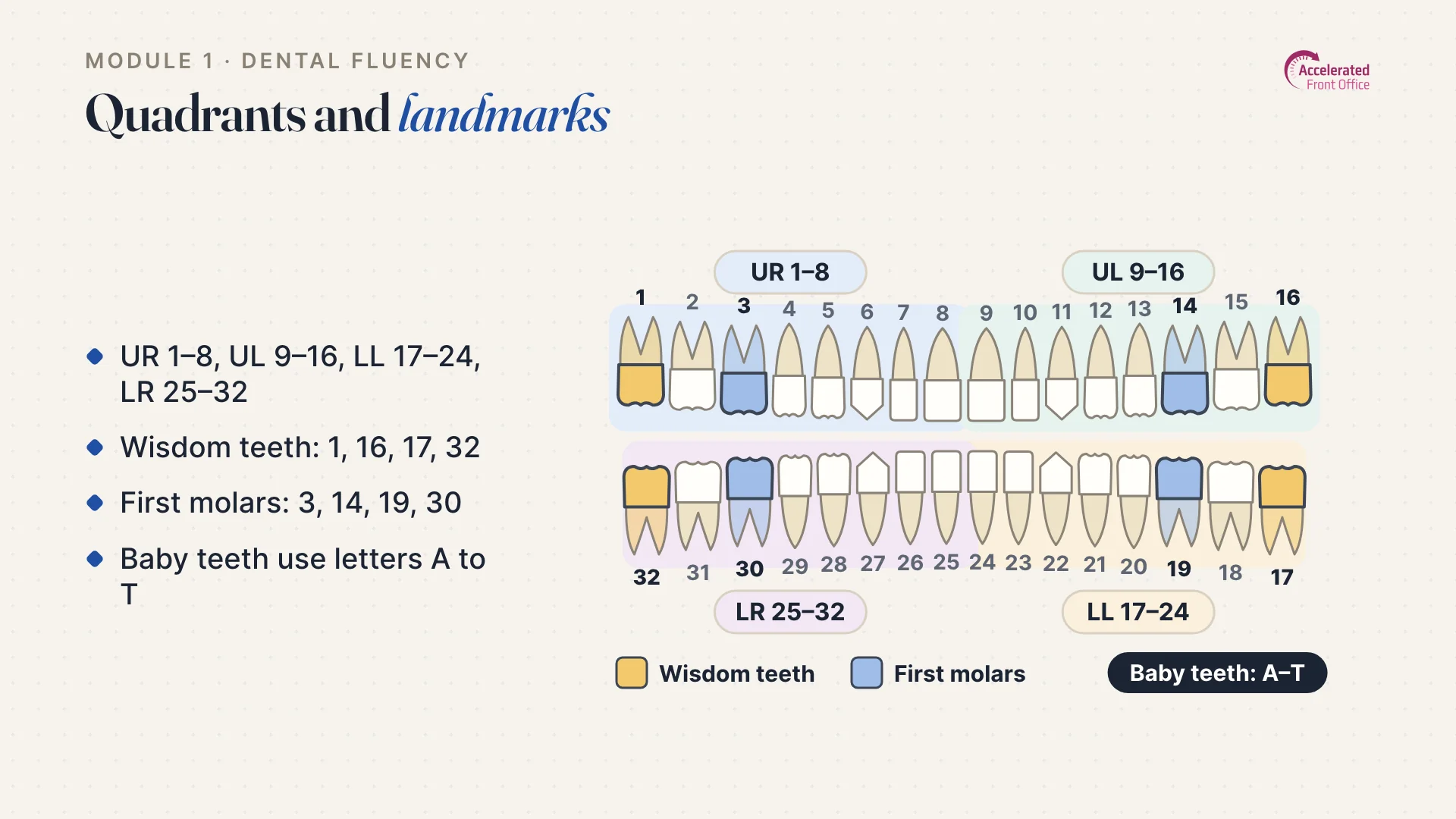
- Adult teeth are numbered 1 to 32. Tooth #1 is the upper right wisdom tooth (the patient's right). Count across the top to #16, the upper left wisdom tooth, then drop down to #17, the lower left wisdom tooth, and count back across the bottom to #32, the lower right wisdom tooth.
- Baby (primary) teeth use letters A to T, in the same order: A is the upper right back baby tooth, J the upper left, K the lower left and T the lower right.
- The mouth is also split into four quadrants: upper right (UR), upper left (UL), lower left (LL) and lower right (LR). Deep cleanings are planned and billed by quadrant.
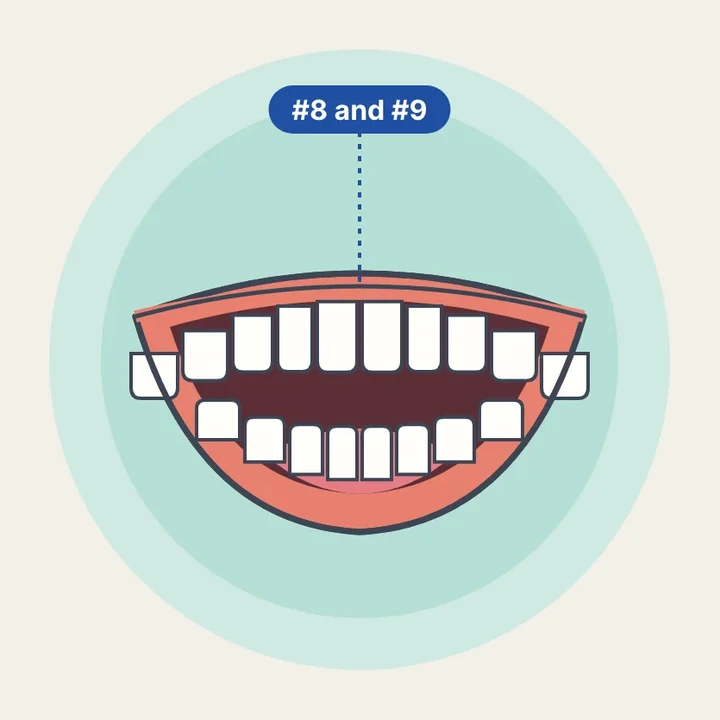
Some useful landmarks: #8 and #9 are the two upper front teeth, and #30 and #19 are the lower first molars, two of the teeth that most often need crowns.
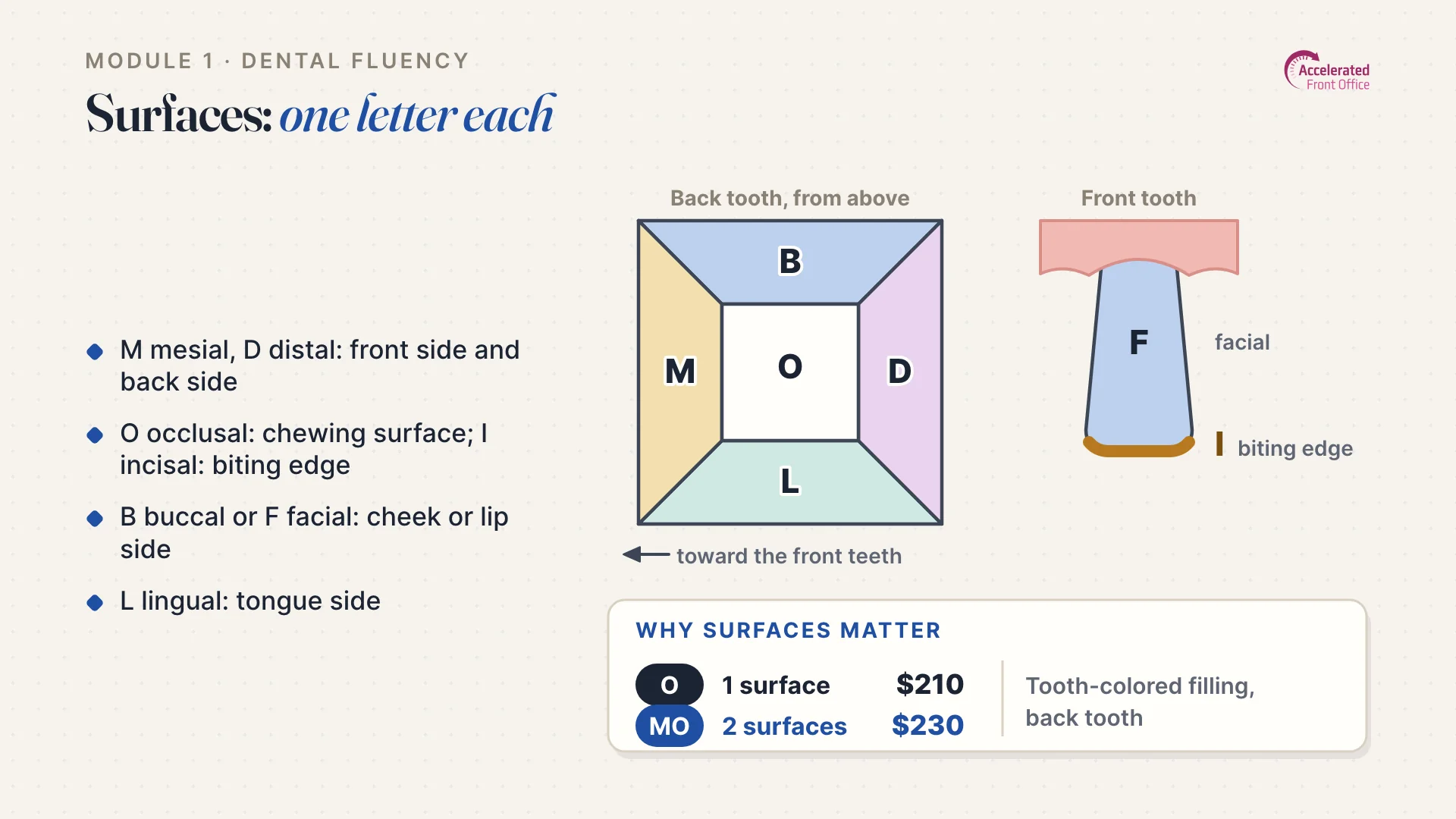
Tooth surfaces
| Letter | Surface | Where it is |
|---|---|---|
| M | Mesial | The side toward the middle of the mouth |
| D | Distal | The side away from the middle |
| O | Occlusal | The chewing surface of a back tooth |
| I | Incisal | The biting edge of a front tooth |
| B or F | Buccal or facial | The side facing the cheek or lips |
| L | Lingual | The side facing the tongue |
Surfaces combine: an "MOD" filling covers the mesial, occlusal and distal surfaces. The number of surfaces changes the code and the fee.
Procedures and the words for them
| You'll hear | It means |
|---|---|
| Prophy | A routine cleaning (prophylaxis) |
| Recall, recare | The regular checkup and cleaning visit |
| Perio, perio maintenance | Gum disease, and the cleanings for a patient who has had gum treatment |
| SRP | Scaling and root planing: a deep cleaning, by quadrant |
| FMX, BWX, PA, pano | Full-mouth x-rays, bitewings, a single periapical x-ray, a panoramic x-ray |
| Comp, composite | A white (tooth-colored) filling |
| Amalgam | A silver filling |
| Crown prep / crown seat | The first crown visit (shape the tooth, temporary crown) and the second (cement the final crown) |
| Buildup | Rebuilding a broken-down tooth before a crown |
| RCT, endo | Root canal treatment |
| Ext | Extraction |
| Premed | Antibiotics some patients take before treatment, as directed by their doctor or dentist |
Front desk and insurance words
| Term | It means |
|---|---|
| NP | New patient |
| Op, operatory | A treatment room |
| Column | One provider's line on the schedule |
| ASAP list | Patients who want an earlier appointment if one opens up |
| Route slip | The day sheet for one patient: what's planned, alerts and notes |
| Tx plan | Treatment plan: the procedures the dentist recommends |
| PPO, DHMO | Preferred provider plan (choose any dentist, lower costs in network); dental HMO (assigned dentist, set copays) |
| Allowed fee | The most an in-network office may charge for a code under a plan |
| Write-off | The difference between the office's fee and the allowed fee, which the office absorbs |
| EOB | Explanation of benefits: how the plan processed a claim (how to read one) |
| COB | Coordination of benefits: which plan pays first when a patient has two |
| Annual max | The most a plan pays in a benefit year |
How to learn it fast
Don't try to memorize lists. Learn the words as you meet them on a schedule, a route slip or an EOB, and quiz yourself a few minutes a day. Front Office Essentials opens with a dental fluency module and simulation (tooth numbers, terms and route slips) and includes a flashcard deck that brings back the terms you miss more often.