Do you need a certification to be a dental receptionist?
You don't. Answering phones, scheduling, checking patients in and out, verifying insurance and taking payments are not licensed tasks in the US. No state board issues a receptionist license, and there is no national exam you must pass before an office can hire you.
That's different from the clinical side of the office. Dental assistants and hygienists work under state rules, and many tasks (taking x-rays, for example) need a state credential. If a job ever mixes front desk work with clinical duties, those clinical duties follow your state's dental assisting rules. Pure front desk work does not.
So why does "dental receptionist certification" get searched so often? Partly because job seekers expect healthcare jobs to need a credential, and partly because many results you'll see are from Canadian colleges and UK course sellers, where programs are named differently. For a US front desk job, what matters is what you can do on day one.
What do dental offices actually look for?
Ask an office manager what makes a great front desk hire and you'll hear the same few things:
- A warm, steady phone voice. The front desk is the first person every patient talks to. Offices want someone who answers the same way every time, gets the caller's name, listens and books the visit.
- Comfort with insurance. Verifying benefits, building an estimate and explaining an explanation of benefits (EOB) to a confused patient are the skills most new hires lack.
- Scheduling sense. Knowing how long a crown prep takes, where emergencies fit and how to fill a last-minute opening keeps the day calm and productive.
- Money conversations. Collecting at checkout, presenting an estimate and talking about a past-due balance kindly but clearly.
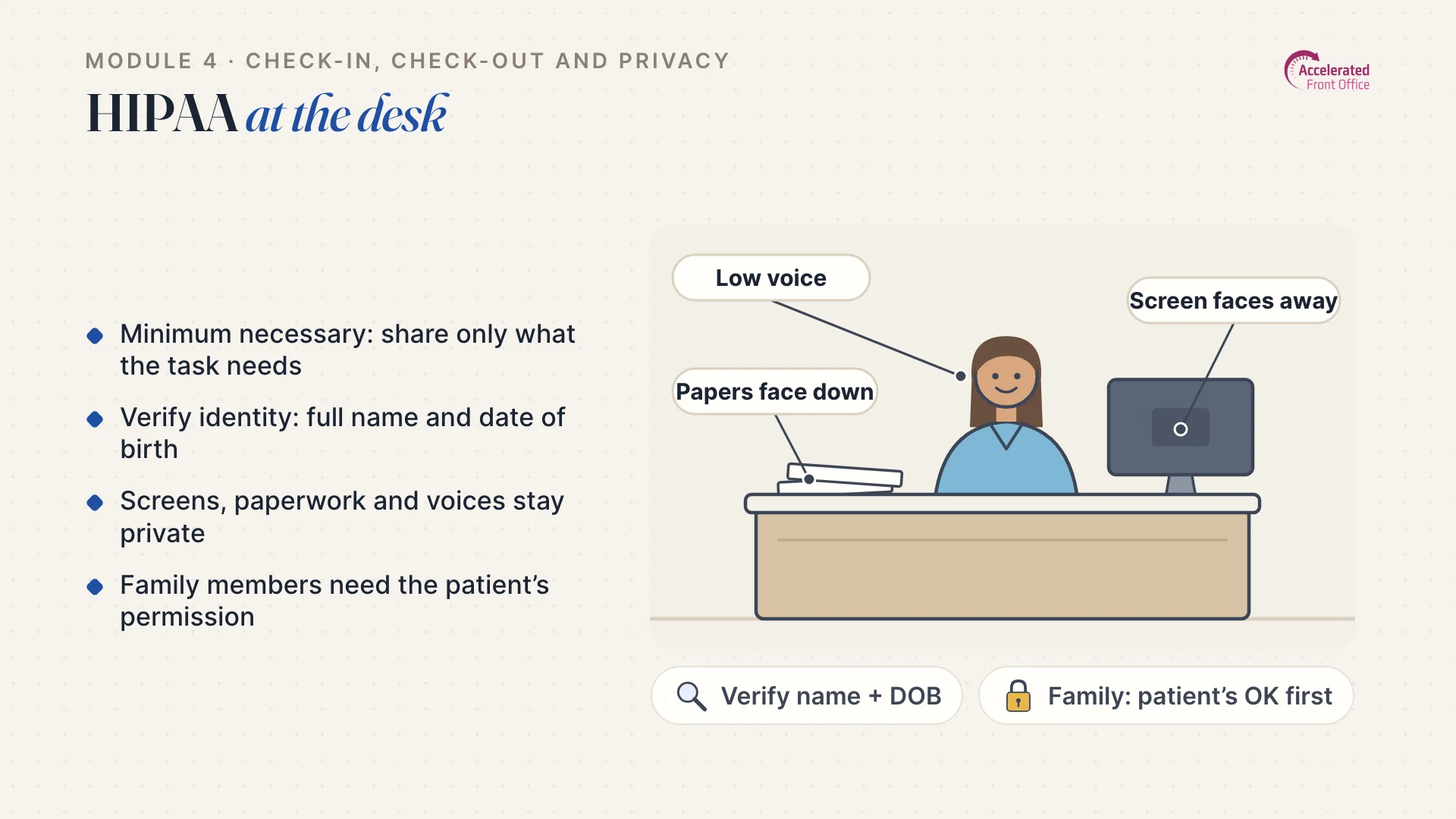
- Discretion. HIPAA basics: verifying who you're talking to before sharing anything, and keeping patient information to the minimum necessary.
- Reliability and attitude. Dental offices are small teams. Showing up on time and staying calm when three things happen at once matters as much as any skill.
Notice what's on the list: skills you can learn and practice. Notice what isn't: a license.
Certificate vs certification: what's the difference?
The words sound alike but mean different things, and it's worth using them correctly on your resume.
| Certificate of completion | Professional certification | |
|---|---|---|
| What it shows | You finished a training program and passed its tests | You passed an exam run by an independent credentialing body |
| Who issues it | The school or course provider | A certifying organization |
| Required for dental front desk jobs? | No, but it helps you stand out | No. None is required for this role |
| How to list it | "Certificate of Completion, Dental Front Office Essentials" | Only if you hold one |
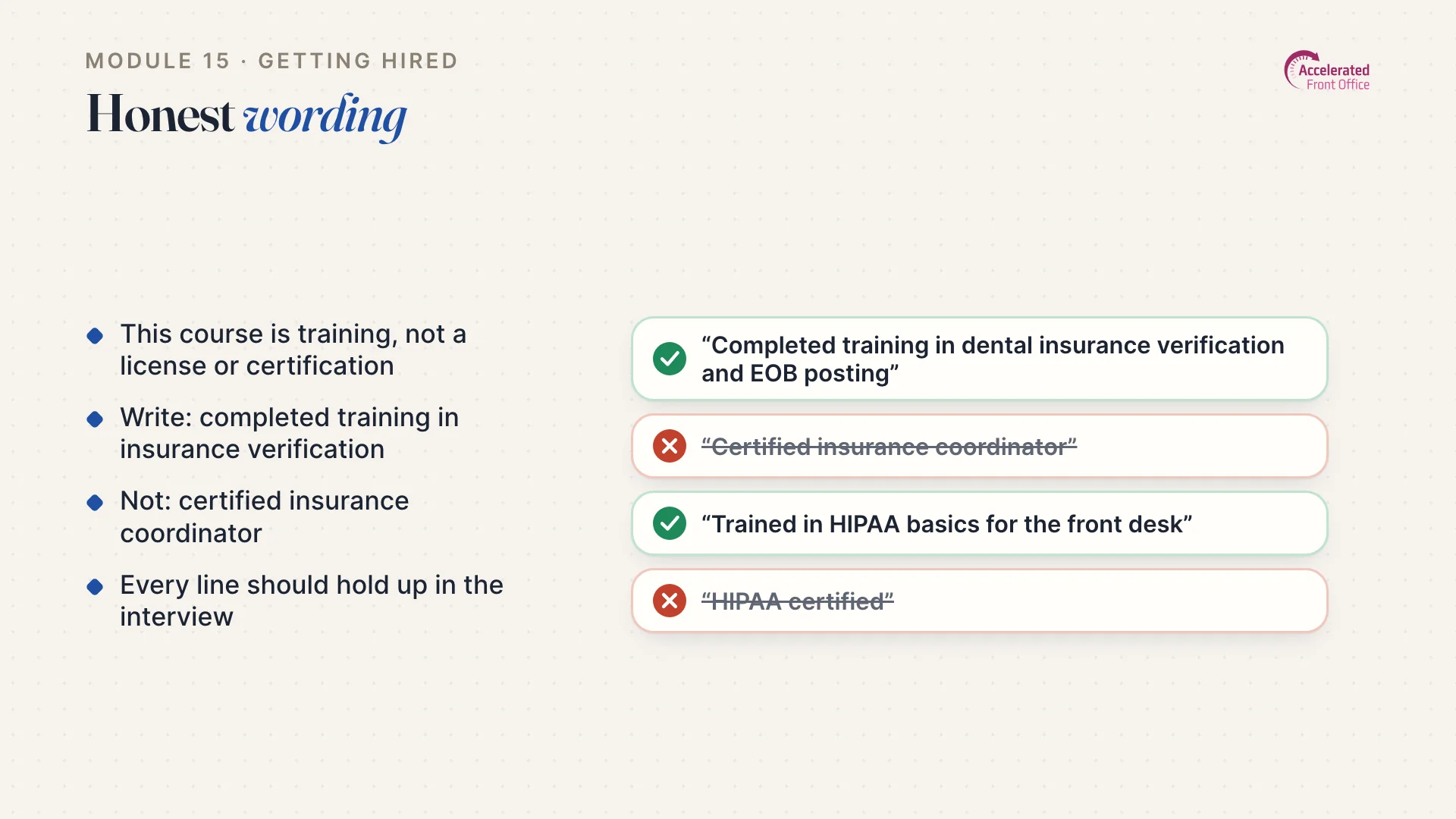
Be careful with programs that promise to make you a "certified dental receptionist." Because no required certification exists, that phrase can mean almost anything. Ask what the certificate proves and whether you practice the real work, or just watch videos about it.
Is a training certificate worth it?
A certificate on its own won't get you hired. What gets you hired is walking into the interview able to talk about insurance and scheduling like someone who has done it. Good training gives you that, and the certificate is the proof you can put on your resume.
It's most worth it if you're:
- Coming from retail, hospitality or a call center, with no dental experience to point to.
- Applying to offices that list "dental experience preferred."
- Already hired and starting soon, and want to be useful in week one instead of week six.
Before you pay for any program, check three things: how much of it is practice rather than video, whether it covers insurance and EOBs (the hardest part of the job), and what it costs. College certificate programs for dental office work commonly run into the thousands of dollars and can take months.
How the Front Office Essentials certificate works
Front Office Essentials ends with a Certificate of Completion. You earn it by finishing every module, which includes:
- 24 practice calls with AI patients, each scored on a checklist of what a great call includes;
- 16 simulations of the real desk, from building a schedule to posting an EOB and closing out the day;
- a check at the end of every module, a capstone "day at the desk," and a final exam.
Each certificate has its own number, and anyone (like an office manager reading your resume) can check the number online to confirm it's real. We call it what it is: a certificate of completion, not a license.
Other credentials that can help
- HIPAA training. Offices must train their staff on privacy, so many will ask you to complete it after you're hired. Knowing the basics before the interview is a plus.
- CPR or Basic Life Support. Some offices ask every team member to hold a current card. It's short, inexpensive and worth asking about.
- A second language. Not a credential, but being bilingual is one of the most valued skills at a busy front desk.
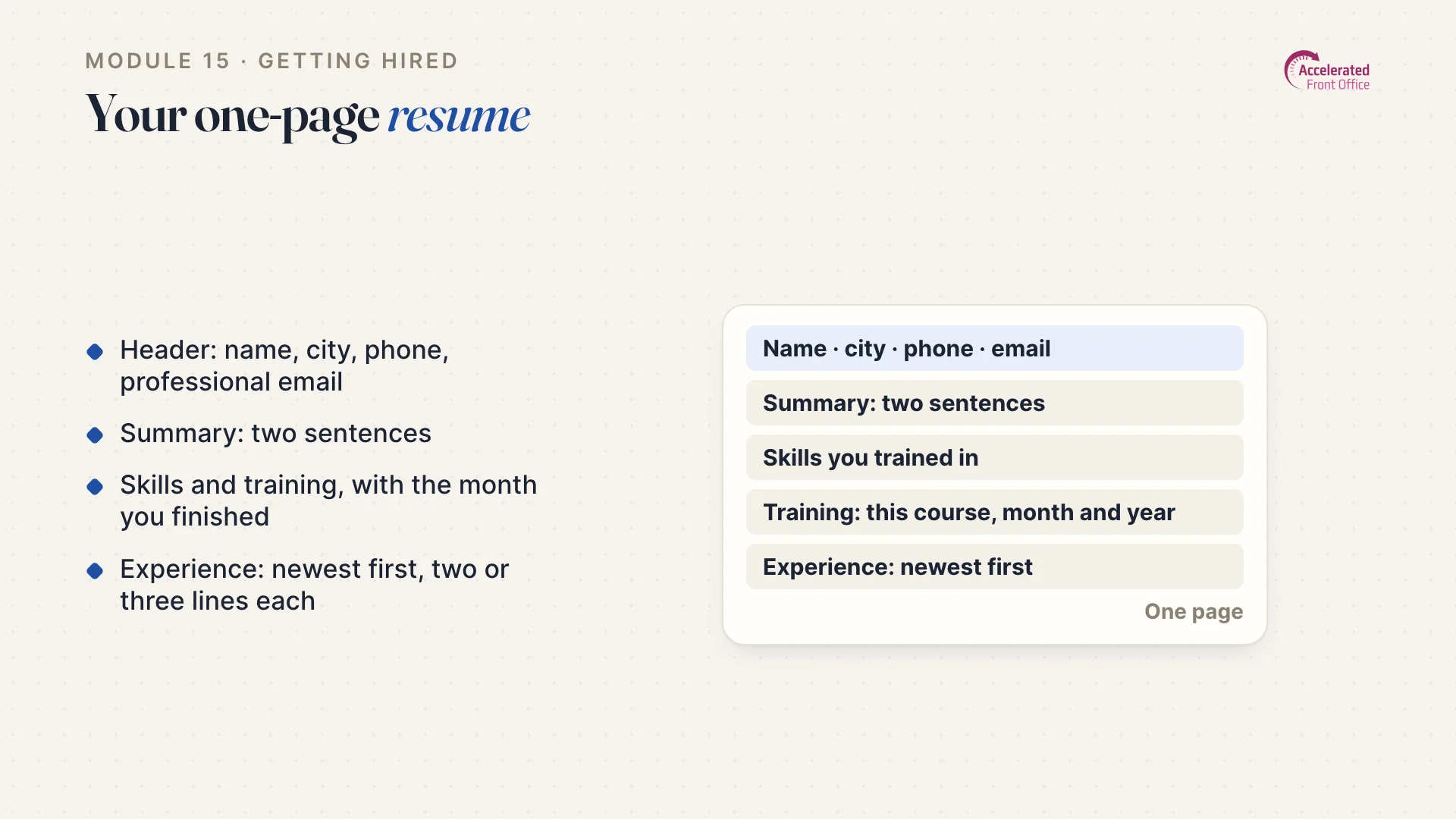
How to list training on your resume
Put it under a heading like "Training" or "Education," with the name of the course and what it covered:
Certificate of Completion, Dental Front Office Essentials (Accelerated Front Office), 2026. Scored practice calls, insurance verification, EOBs, scheduling and practice management software.
Then use what you practiced in your interview answers. "In my training I handled a call from a patient upset about a bill" is far more convincing than "I'm a fast learner."
Common questions
Is there a national dental receptionist certification in the US?
No. There is no required national or state certification or license for dental front desk work in the US. Offices hire for skills, and a training certificate of completion is one way to show them.
Can I get hired as a dental receptionist without a certificate?
Yes. Many dental receptionists are hired with customer service experience and trained on the job. Training before you apply helps you stand out, especially if you have no dental experience.
Is Front Office Essentials a certification?
No. It's an online course that ends with a certificate of completion, which shows you finished the training, including scored practice calls, simulations and a final exam. Employers can verify the certificate number online.