Why verification matters
Almost every billing dispute at a dental office starts the same way: a patient was told (or assumed) their insurance would cover something, and it didn't. Verifying benefits before the visit lets you give a real estimate, collect the right amount at checkout and avoid the angry phone call a month later.
At Maple Grove Dental, the practice our course is set in, the front desk verifies every patient's benefits three business days before the appointment. That leaves time to call the patient if something's off.
Before you start: what you need from the patient
- Patient's full name and date of birth.
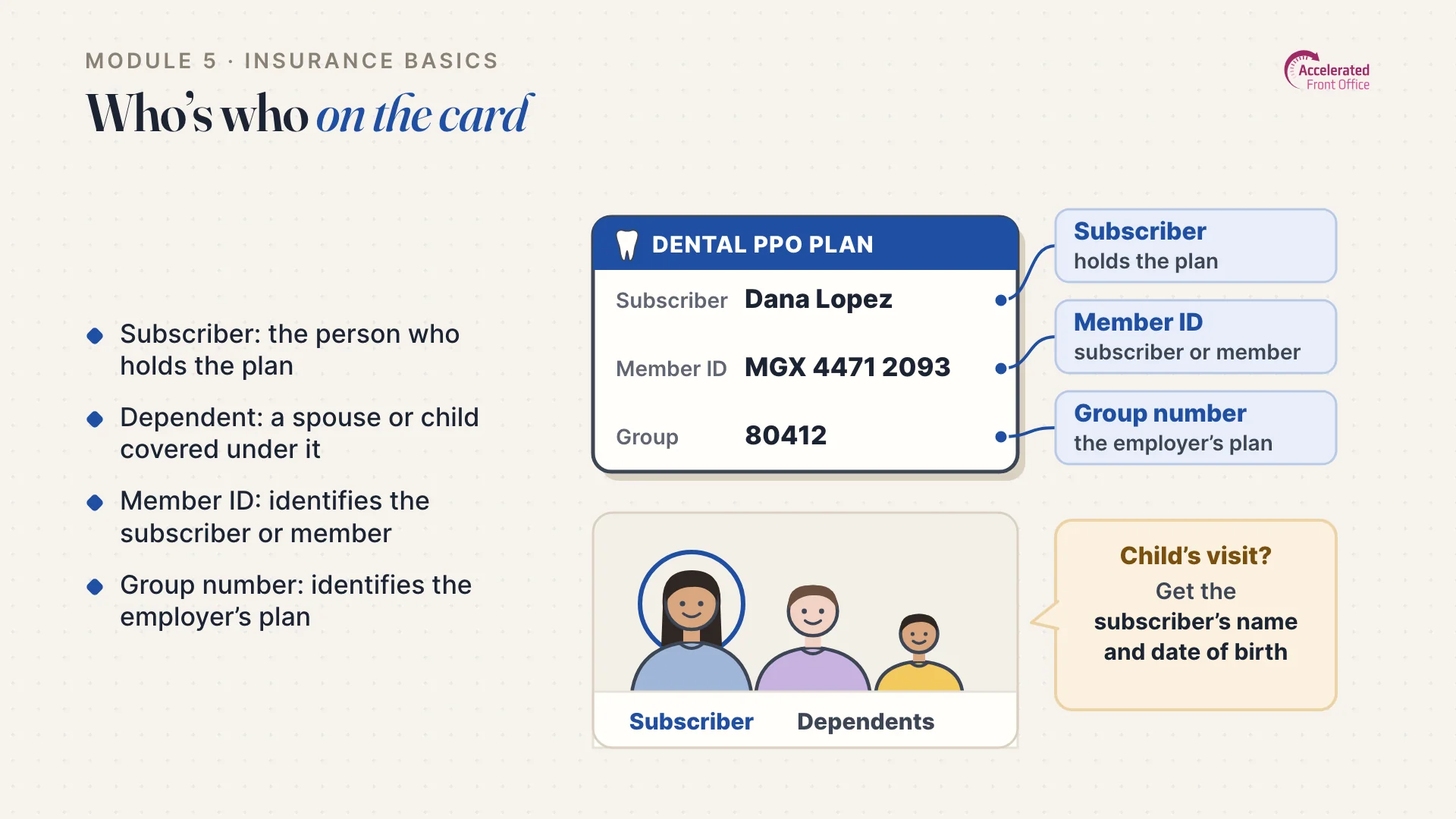
- Subscriber's name and date of birth (the person who holds the plan, often through their job).
- Member ID and group number from the card, and the employer.
- The patient's relationship to the subscriber (self, spouse, child).
- Any second plan the patient is covered by.
Get these at booking. A photo of the front and back of the card saves a lot of guessing.
The verification checklist
Ask or look up every item
- Is the plan active today and on the appointment date?
- Plan type (PPO, DHMO, indemnity) and whether we're in network.
- Deductible: how much, individual and family, and how much is met this year. Does it apply to preventive care?
- Annual maximum, and how much is left. When does the benefit year reset?
- Coverage percentages for preventive, basic and major services.
- Frequency limits for exams, cleanings, bitewings, full-mouth x-rays, fluoride and periodontal maintenance, and the dates last used.
- Waiting periods for basic or major services on a new plan.
- Missing tooth clause (will the plan replace a tooth that was missing before coverage began?).
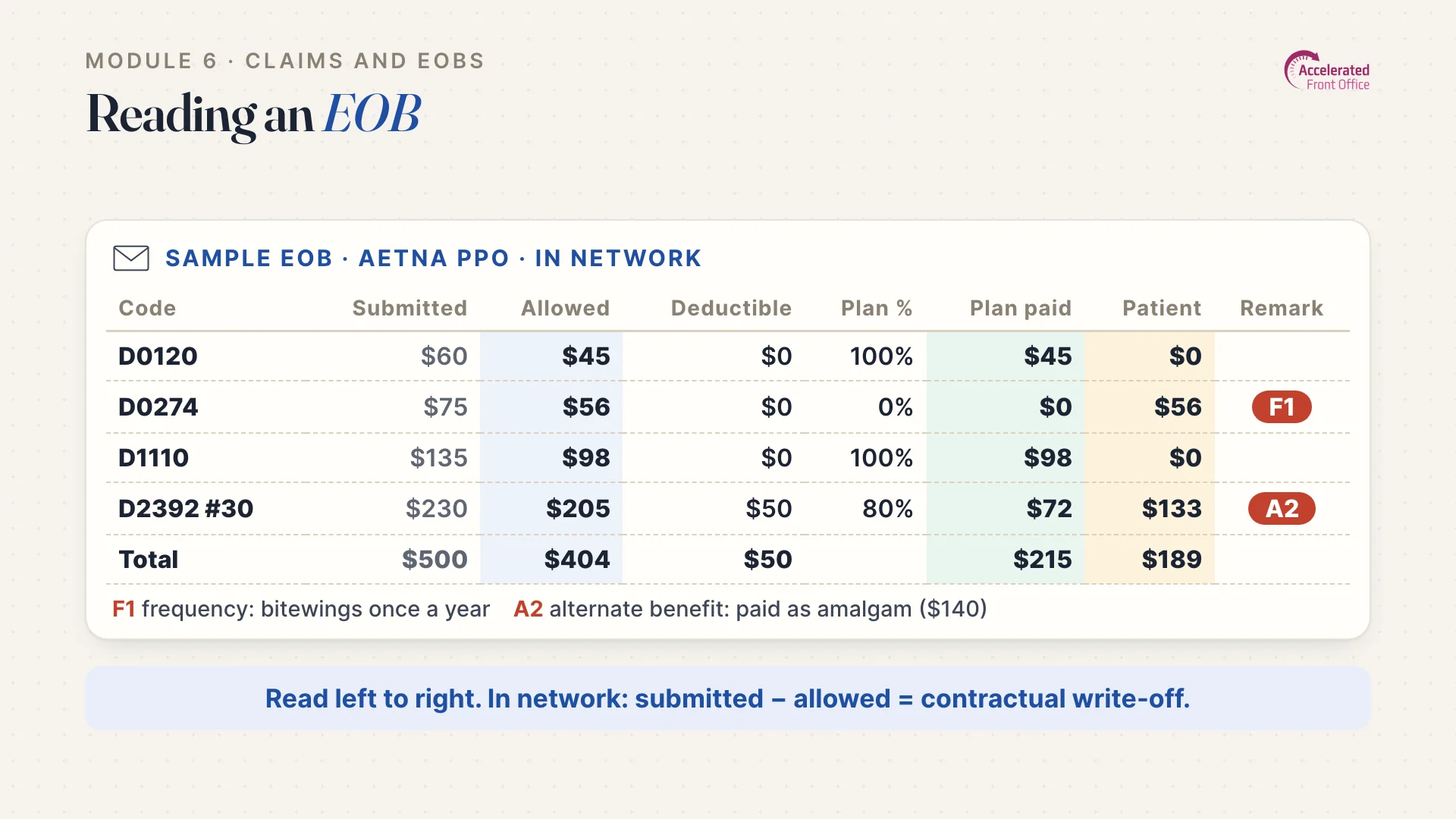
- Alternate benefits (downgrades): are back-tooth white fillings paid at the silver filling rate?
- Coordination of benefits: is there another plan, and which pays first?
- The name of the person you spoke with, the date, and a call reference number.
Many plans answer most of this on their provider portal. Call when the portal is unclear or the treatment is large.
A short script for the insurance call
"Hi, this is Taylor from Maple Grove Dental, an in-network provider. I'm calling to verify benefits for a patient. The subscriber is Dana Ortiz, date of birth March 14, 1991, member ID ending in 4471. The patient is the subscriber. Her appointment is Tuesday for a new patient exam, full-mouth x-rays and a cleaning."
Then work down your checklist in order, read back anything that sounds unusual, and always end with: "Can I get your name and a reference number for this call?"
Practicing this call is one of the 24 practice calls in Front Office Essentials: you call MetLife provider services, with an AI rep who answers like a real one, and fill in a benefits breakdown as you go.
Turning benefits into an estimate
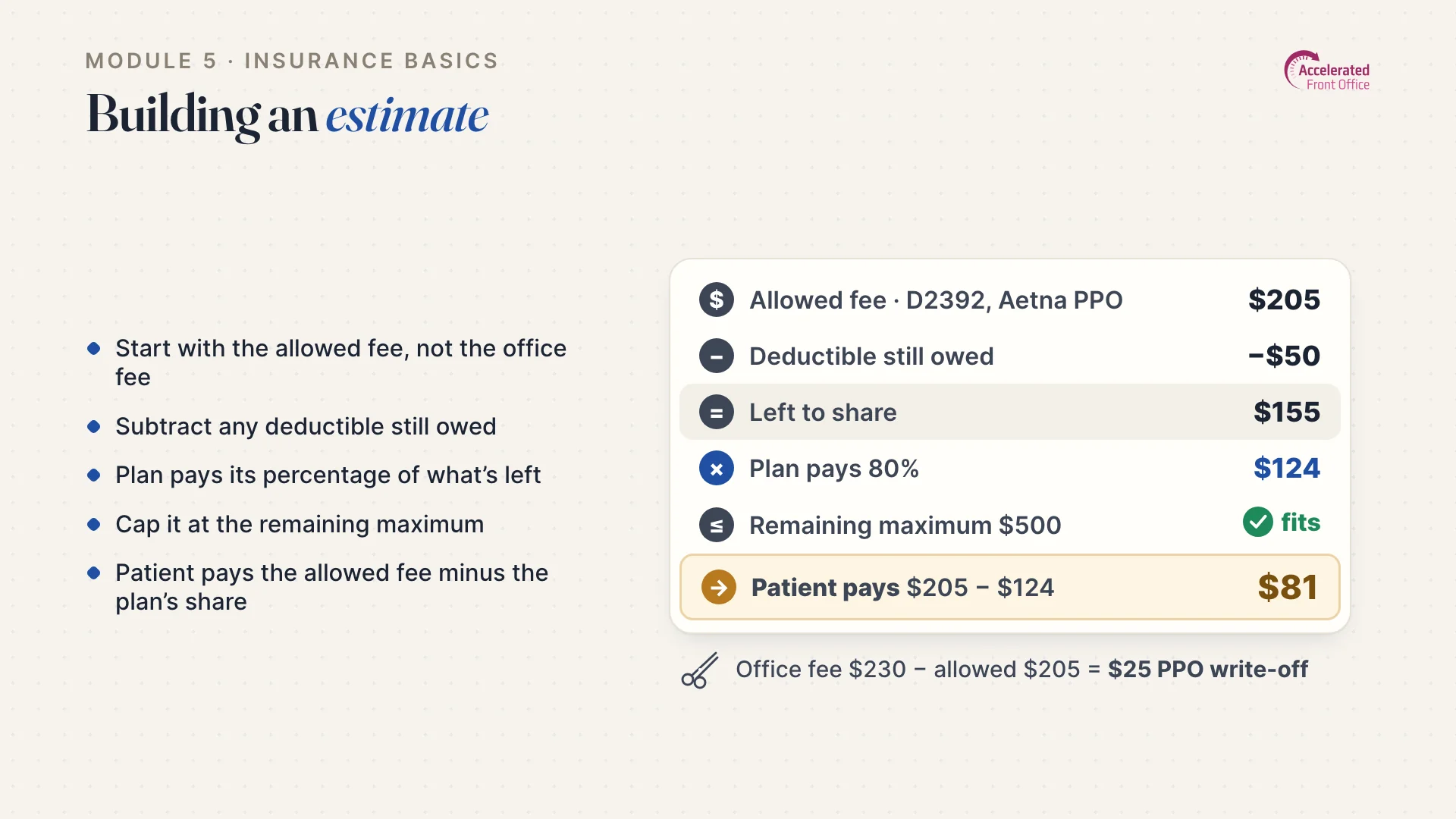
An estimate takes three numbers: the allowed fee (what an in-network plan lets you charge), what's left of the deductible, and the coverage percentage. Here's a worked example from the course.
A patient with Delta Dental PPO needs a porcelain crown (D2740). Maple Grove's full fee is $1,350, but Delta's allowed fee is $1,040. Her plan pays major services at 50%, and she has $50 of her deductible left.
| Step | Math | Result |
|---|---|---|
| Start from the allowed fee | $1,040 | |
| Subtract the remaining deductible | $1,040 − $50 | $990 |
| Plan pays its percentage | $990 × 50% | $495 |
| Patient's estimated portion | $1,040 − $495 | $545 |
| Contractual write-off (in network) | $1,350 − $1,040 | $310 |
Check that $495 fits in what's left of her annual maximum. If only $300 remains, the plan pays $300 and her portion goes up. Always present this as an estimate: the plan decides what it pays when the claim is processed.
Common surprises verification catches
- Frequency limits: bitewings already taken this year at another office, so the plan won't pay again.
- Waiting periods: a new plan that won't cover a crown for 12 months.
- Downgrades: a white filling on a back tooth paid at the silver filling rate, leaving the patient the difference.
- Maxed-out benefits: a patient who already used most of their annual maximum.
- Out of network: the office can still treat the patient, but the plan's allowance may be lower and the patient pays the difference.
What to say to the patient
Never promise coverage. Say what you found and that it's an estimate:
"I checked your Delta Dental benefits. Based on what they told us, your estimated portion for the crown is $545. Your plan makes the final decision when they process the claim, but this is our best estimate, and it's what we'll collect at your visit."