What CDT codes are
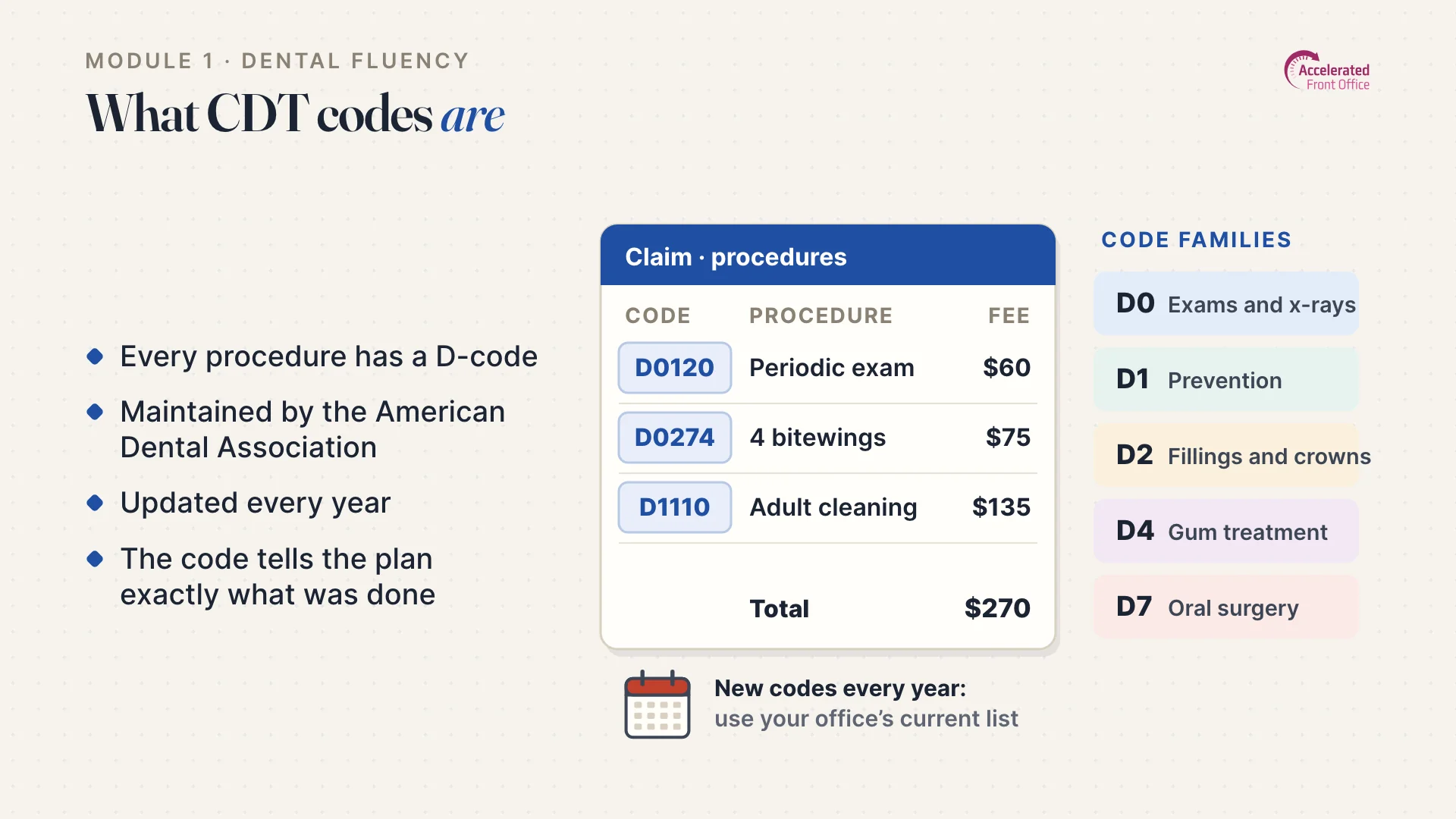
CDT stands for Current Dental Terminology. Each code starts with D and four digits, and the first digit tells you the category: D0 for exams and x-rays, D1 for preventive care, D2 for fillings and crowns, D4 for gum treatment, D7 for oral surgery, and so on. Your office's software has the full, current list; you don't need to memorize it, but you'll know the common ones within weeks.
The codes you'll see every day
Fees are Maple Grove Dental's, the invented practice in our course. Every office sets its own.
| Code | In plain words | Example fee |
|---|---|---|
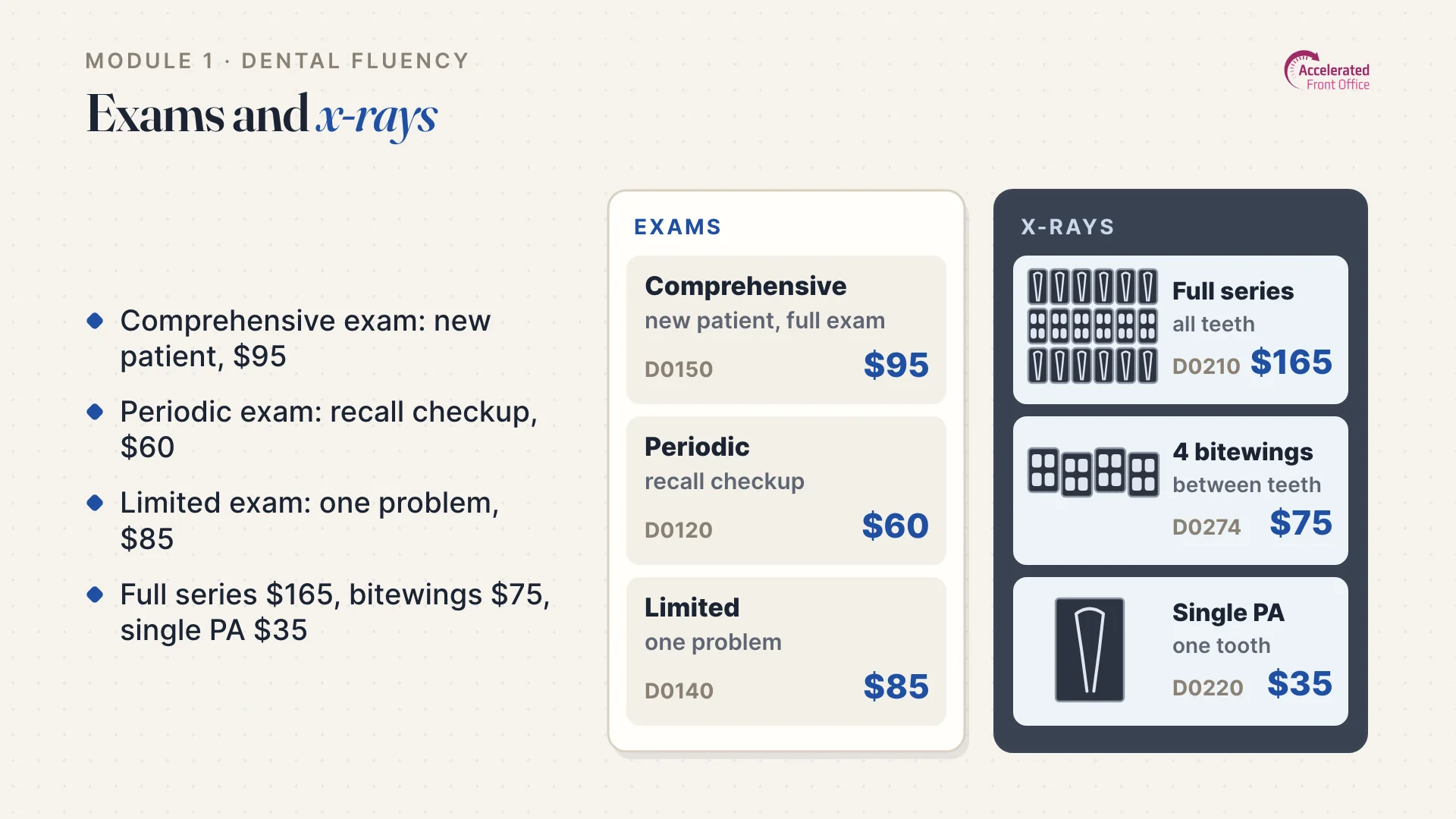
| D0150 | Comprehensive exam: the full exam at a new patient's first visit | $95 |
| D0120 | Periodic exam: the routine exam at a checkup | $60 |
| D0140 | Limited exam: a problem-focused exam, usually an emergency | $85 |
| D0210 | Full-mouth x-rays (FMX) | $165 |
| D0220 | One periapical x-ray (the whole tooth, root included) | $35 |
| D0274 | Four bitewing x-rays (BWX): checks between back teeth | $75 |
| D1110 | Adult cleaning ("prophy") | $135 |
| D1120 | Child cleaning | $95 |
| D1206 | Fluoride varnish | $45 |
| D1351 | Sealant, per tooth | $60 |
| D4341 | Scaling and root planing (deep cleaning), 4 or more teeth in a quadrant | $280 per quadrant |
| D4342 | Scaling and root planing, 1 to 3 teeth in a quadrant | Varies |
| D4910 | Periodontal maintenance: the cleaning for a patient who has had gum treatment | $165 |
| D2391 | White (composite) filling, one surface, back tooth | $210 |
| D2392 | White (composite) filling, two surfaces, back tooth | $230 |
| D2950 | Core buildup: rebuilds a tooth so a crown has something to hold | $295 |
| D2740 | Porcelain/ceramic crown | $1,350 |
| D7140 | Simple extraction of a tooth that has come in | $210 |
Codes that get mixed up
D0150 vs D0120
D0150 is the comprehensive exam, used for new patients (or established patients with a big change in health). D0120 is the routine recall exam. Booking a new patient's exam as D0120 under-bills; billing a routine checkup as D0150 can be denied.
D1110 vs D4910
Once a patient has had scaling and root planing (D4341 or D4342), their regular cleanings usually become periodontal maintenance (D4910), not adult cleanings (D1110). Plans cover them differently, so it changes the patient's estimate.
D4341 vs D4342
Both are deep cleaning, billed per quadrant. D4341 is four or more teeth in the quadrant; D4342 is one to three.
D0274 frequency
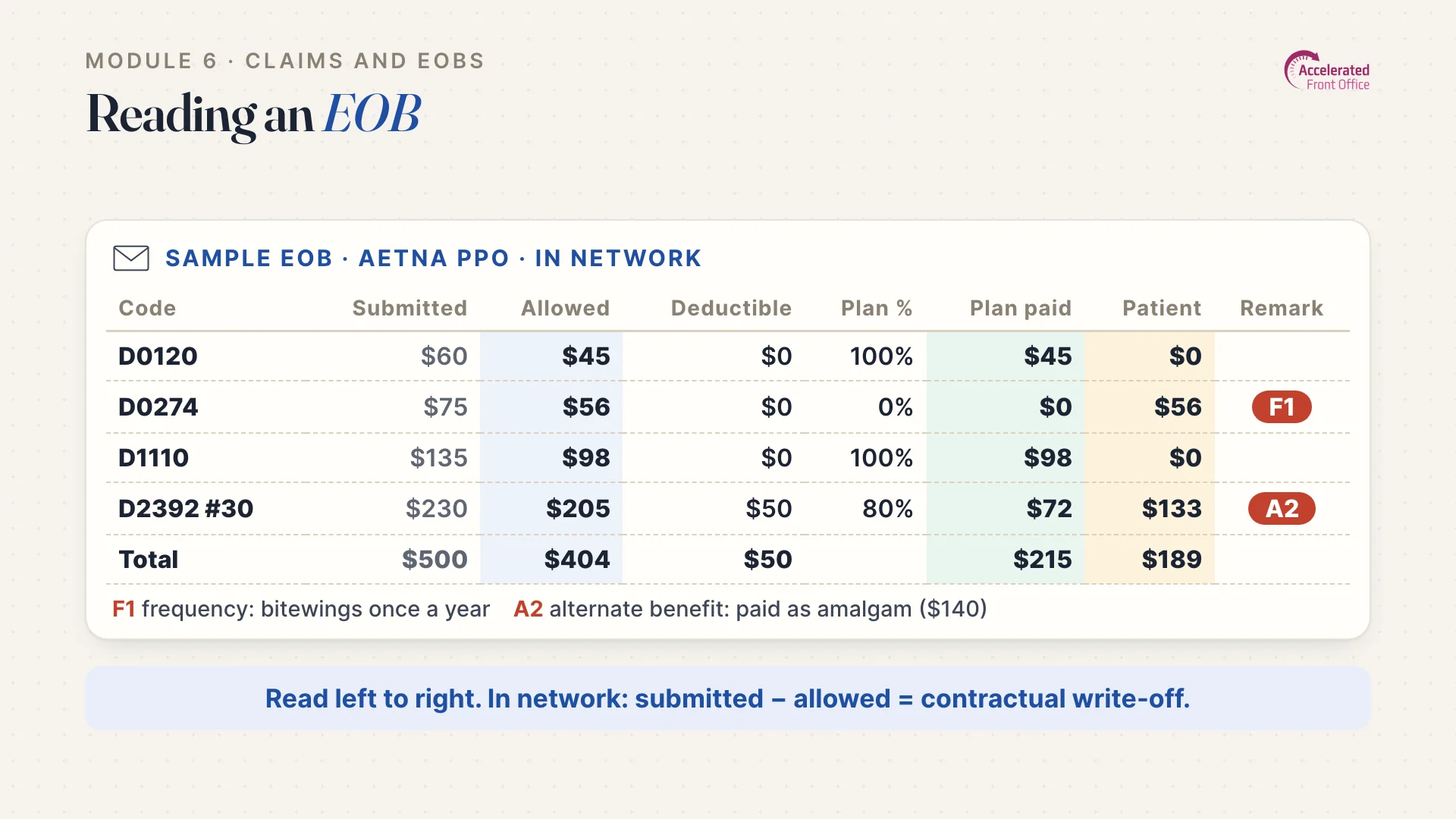
Many plans pay for bitewings once per calendar year (or once every 12 months). Check the date of the last set during verification; it's one of the most common reasons a claim comes back unpaid.
Tooth numbers and surfaces go with the code
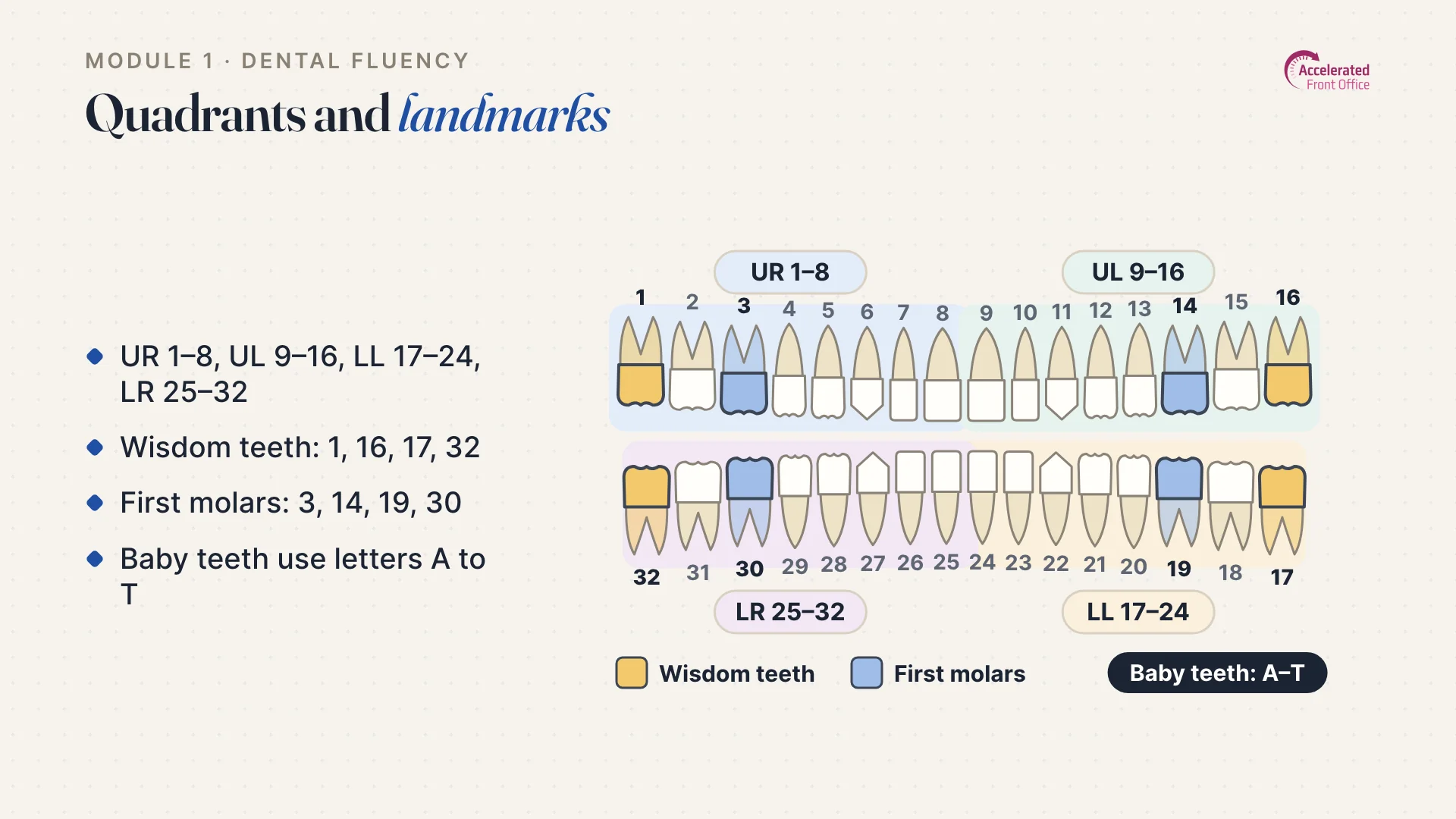
Fillings, crowns and extractions need a tooth number, and fillings need the surfaces: "D2392 #30 MO" means a two-surface white filling on tooth 30, mesial and occlusal surfaces. A missing tooth number is a common reason a claim is rejected. See our dental terminology guide for numbering and surfaces.
Where the front desk uses codes
- Scheduling: the code tells you how long the visit is and which column it goes in.
- Verification: you ask about coverage and frequency for the specific codes planned.
- Estimates: each code has its own allowed fee and coverage level.
- Claims and EOBs: every line of an EOB is a code. See how to read an EOB.